
Choosing the right Trina Solar panel starts with focusing on what matters most to you. You want reliable performance, real savings, and panels built to last. Many buyers share these top concerns:
Lowering electricity bills with efficient Trina pv panel options.
Finding high-performance modules, such as advanced n-type TOPCon models.
Ensuring durability, especially in areas where hail can damage panels.
By understanding your priorities, you can confidently select a solution that meets your needs.
Key Takeaways
Identify your energy goals before choosing a Trina Solar panel. Focus on wattage, efficiency, and durability to meet your needs.
Select a wattage that matches your roof space. Higher wattage panels generate more power with fewer units, ideal for limited areas.
Look for high-efficiency panels. Trina Solar models reach up to 21.0% efficiency, allowing for better performance in low-light conditions.
Check the size and weight of panels. Ensure your roof can support the total weight and that the dimensions fit your installation area.
Review warranty options carefully. Trina Solar offers product warranties up to 12 years and performance warranties up to 30 years for peace of mind.
Consider temperature effects on performance. Trina Solar panels maintain strong output even in high heat, but good airflow is essential.
Verify certifications for safety and quality. Look for IEC/UL and ISO certifications to ensure your panels meet industry standards.
Consult authorized distributors for genuine products. This ensures you receive full warranty protection and expert support during your purchase.
Key Trina Solar panel specs

Wattage
Range
When you compare solar panels, wattage tells you how much power each panel can produce under ideal conditions. Trina Solar panel models offer a wide range of wattages to fit different needs. Here is a quick comparison:
Model Type | Wattage Range |
|---|---|
Vertex S+ | 420 – 445 W |
Vertex S | 380 – 405 W |
Residential | 310 – 380 W |
Industry Average | Up to 700 W or more |
You see that Trina Solar panel wattages cover most residential and commercial requirements. While some industry panels now reach 700W or more, most homes and small businesses find the 310W to 445W range ideal for rooftop installations.
Matching needs
You should choose a wattage that matches your energy goals and available roof space. For example, if you have limited space, higher-wattage panels let you generate more power with fewer panels. If you have a large roof or ground area, you can use more panels with lower wattage. Always check your inverter’s maximum input and your local utility’s rules before finalizing your choice.
Tip: Monocrystalline panels, like those in the Vertex series, offer higher wattage and efficiency, making them a strong choice for maximizing output in tight spaces.
Efficiency
What it means
Efficiency measures how well a solar panel converts sunlight into usable electricity. A higher efficiency rating means the panel produces more power from the same amount of sunlight. Trina Solar panel models typically reach up to 21.0% efficiency, which is among the best in the industry.
Brand | Efficiency Rate |
|---|---|
Trina Solar | 21.0% |
Why it matters
You benefit from higher efficiency in several ways. First, you need fewer panels to reach your energy target, which saves space and reduces installation costs. Second, high-efficiency panels perform better in low-light or cloudy conditions. However, real-world factors like temperature, shading, and weather can reduce actual energy production by 10-40%. Always consider these factors when planning your system.
Note: Bifacial panels can boost energy yield by capturing sunlight from both sides, increasing total output by up to 30% compared to standard panels.
Size
Space
The physical size of your Trina Solar panel affects how many panels you can install and how much power you can generate. Standard residential panels measure about 65 inches by 39 inches (1.65 x 1 meters), while commercial panels are larger at 77 inches by 39 inches (1.96 x 1 meters).
Type | Dimensions (inches) | Dimensions (meters) |
|---|---|---|
Residential | 65 x 39 | 1.65 x 1 |
Commercial | 77 x 39 | 1.96 x 1 |
The size determines how many panels fit on your roof.
Larger commercial panels may not suit smaller residential roofs.
Always check your roof’s usable area before selecting panel size.
Weight
Panel weight impacts installation and roof safety. For example, the Vertex S+ 440W model weighs about 21.1 kg. Most domestic panels weigh between 19 kg and 30 kg, while commercial panels can reach 35 kg.
Ensure your roof can support the total weight of the array.
Consider local snow and wind loads.
Check the age and material of your roof for compatibility.
Reminder: Always consult a qualified installer to assess your roof’s structure before installing any solar panels.
Warranty
Types
When you invest in solar panels, warranty coverage protects your purchase and ensures long-term value. Trina Solar offers two main types of warranties:
Product Warranty: Covers defects in materials or workmanship. This warranty gives you peace of mind that your panels will function as promised.
Performance Warranty: Guarantees a minimum power output over a set period. You can expect your panels to deliver reliable energy for decades.
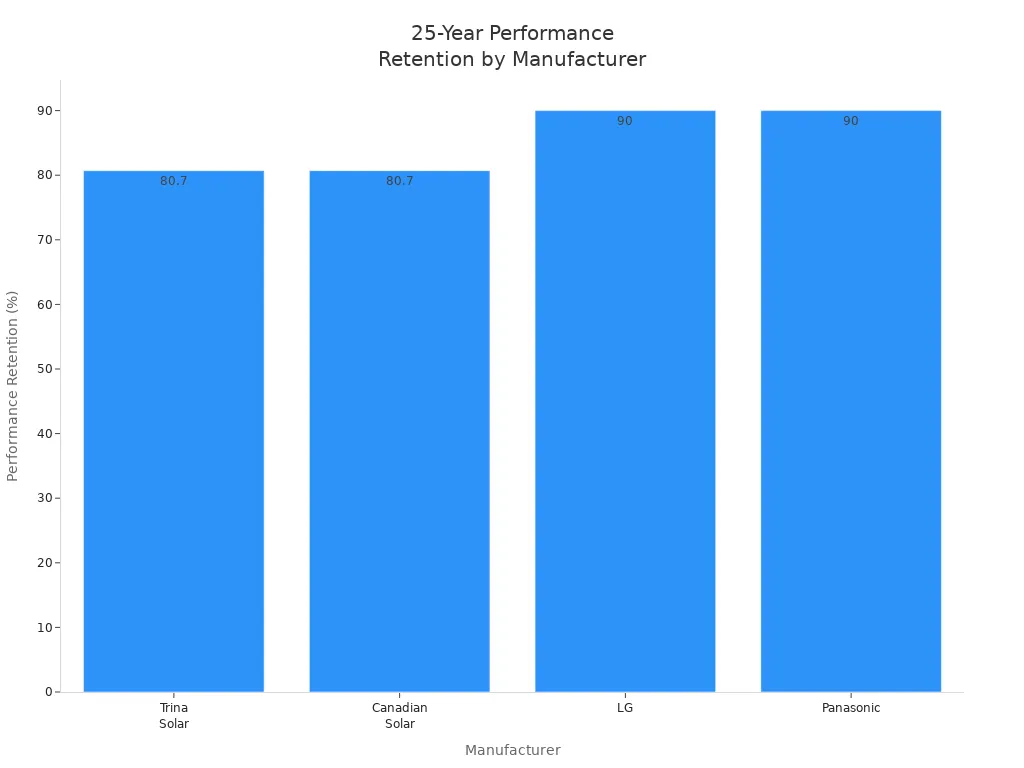
Here is how Trina Solar’s warranties compare to other leading manufacturers:
Manufacturer | Product Warranty | Performance Warranty | Performance Retention at 25 Years |
|---|---|---|---|
Trina Solar | 10 years | 25 years | |
Canadian Solar | 10 years | 25 years | 80.7% |
LG | 25 years | 25 years | Over 90% |
Panasonic | 25 years | 25 years | Over 90% |
Terms
You should always review the warranty terms before making a decision. Trina Solar panel warranties typically include:
Warranty Type | Duration | Degradation Rate |
|---|---|---|
Product Warranty | 12 years | N/A |
Performance Warranty | 30 years | 2% first-year, 0.45% subsequent |
The product warranty covers you for manufacturing defects for up to 12 years.
The performance warranty ensures that after 30 years, your panels will still produce at least 80.7% of their original output.
The degradation rate means you lose only 2% in the first year and just 0.45% each year after.
Tip: Always keep your purchase documents and register your panels with the manufacturer to make warranty claims easier.
Temperature
Output
Temperature affects how much electricity your solar panels generate. Every solar panel has a temperature coefficient, which tells you how much power output drops as the temperature rises. For Trina Solar panels, the temperature coefficient is -0.34%/°C.
For every degree Celsius above 25°C, your panel’s output drops by 0.34%.
If your panel reaches 45°C, you can expect a power loss of about 6.8%.
Climate
If you live in a hot climate, you need to consider this effect. High temperatures can reduce the efficiency of your system, especially during peak sunlight hours. You can minimize losses by installing panels with good airflow underneath or choosing lighter-colored mounting surfaces.
Note: While all solar panels lose some efficiency in the heat, Trina Solar panel models maintain strong performance compared to many competitors.
Certifications
Common types
Certifications show that your solar panels meet strict industry standards for safety, quality, and performance. Trina Solar panels typically carry the following certifications:
Certification Type | Importance |
|---|---|
IEC/UL Standards | Ensures performance, reliability, and fire safety |
ISO Certifications | Indicates quality management and environmental management |
Importance
You should always check for these certifications before buying. Panels with IEC/UL and ISO certifications have passed rigorous testing for durability, electrical safety, and environmental impact. These certifications also help you qualify for rebates and incentives in many regions.
Reminder: Certified panels protect your investment and ensure your system meets local regulations.
Reading datasheets
Overview
Sections
When you review a Trina Solar panel datasheet, you see several important sections. Each section gives you specific details about the solar panel’s performance and build. You should focus on these areas to make a smart buying decision:
Key Section | Details |
|---|---|
Power Output | 645W to 670W |
Efficiency | 20.8% to 21.6% |
Warranty | 10 years product, 25 years power output |
Physical Dimensions | 2384 x 1303 x 33 mm |
Cell Type | PERC, Half Cell, Mono |
Performance Data (STC) | Peak Power, Voltage, Current |
Performance Data (NOCT) | Maximum Power, Voltage, Current |
You find these sections in every Trina Solar panel datasheet. They help you compare solar panels and choose the best option for your solar energy system.
Key numbers
You should pay close attention to the numbers in each section. Power output and efficiency show how much electricity the panel can produce. Warranty terms protect your investment. Physical dimensions and cell type affect installation and compatibility. Performance data under Standard Test Conditions (STC) and Nominal Operating Cell Temperature (NOCT) tell you how the panel works in real-world settings.
Tip: Always check the warranty period and efficiency rating before you buy any solar panels.
Electrical specs
Pmax
Pmax stands for maximum power output. This number tells you the highest wattage the panel can deliver under ideal sunlight and temperature. For example, Trina Solar Vertex panels list Pmax values from 645W to 670W. You should match Pmax to your energy needs and available space.
Voc
Voc means open-circuit voltage. It shows the highest voltage the panel produces when not connected to a load. You need to know Voc to ensure your inverter and other equipment can handle the voltage safely.
Isc
Isc stands for short-circuit current. This value tells you the maximum current the panel generates when its output terminals are shorted. You use Isc to size your wiring and protection devices.
Vmp/Imp
Vmp is the voltage at maximum power, and Imp is the current at maximum power. These numbers show the panel’s operating point when producing peak energy. You use Vmp and Imp to design your solar energy system for the best performance.
Note: Always compare these electrical specs across different Trina Solar panel models to find the best fit for your installation.
Mechanical data
Dimensions
Panel size affects how many solar panels you can install. For example, the Trina Solar 400W panel measures 79.33 x 39.21 x 1.38 inches. Larger panels may suit commercial projects, while smaller panels fit residential roofs.
Weight
Weight matters for installation and roof safety. Most Trina Solar panels weigh between 19 kg and 30 kg. You should confirm your roof can support the total weight of your solar energy system.
Load
Load ratings show how much pressure the panel can handle from wind, snow, or other forces. Trina Solar panels, such as the Vertex S Plus, support up to 5400Pa (112lb/ft²) on the front and 2400Pa (50lb/ft²) on the back.
Model | Dimensions (inches) | Max Static Load (Front) | Max Static Load (Back) |
|---|---|---|---|
Trina Solar 400W | 79.33 x 39.21 x 1.38 | 5400Pa (112lb/ft²) | 2400Pa (50lb/ft²) |
Vertex S Plus | — | 5400Pa (112lb/ft²) | 2400Pa (50lb/ft²) |
Reminder: Always check mechanical data to ensure your solar panels meet local building codes and withstand your climate.
Performance charts
IV curves
When you review Trina Solar panel datasheets, you often see IV curves. These charts show how current (I) and voltage (V) change as sunlight intensity varies. IV curves help you understand how your solar panels perform in real-world conditions, not just in the lab. You can use these charts to compare different solar panel models and select the best option for your solar energy system.
The IV curve reveals several important parameters that affect solar panel performance:
Parameter | Description |
|---|---|
Series Resistance | Impacts efficiency by affecting current flow. |
Reverse Saturation Current | Influences power generation under low light. |
Photocurrent | Shows the current produced under sunlight, crucial for output. |
Ideality Factor | Indicates how closely the panel matches ideal solar cell behavior. |
Shunt Resistance | Affects leakage current and overall efficiency. |
You should pay attention to these values when comparing Trina Solar panels. High series resistance or low shunt resistance can reduce efficiency. A strong photocurrent means better performance in bright conditions. The ideality factor helps you judge how well the panel converts sunlight into electricity.
Temp charts
Temperature charts show how panel output changes as the temperature rises. You see that Trina Solar panels, like the Vertex series, lose some efficiency in hot weather. The temperature coefficient tells you how much power drops for each degree above 25°C. For example, a coefficient of -0.34%/°C means the panel loses 0.34% output for every degree increase.
You should use temperature charts to estimate how much energy your solar panels will produce during summer or in hot climates. Panels with lower temperature coefficients perform better in high heat. This information helps you choose the right solar panels for your location and maximize your solar energy investment.
Example
Walkthrough
Let’s walk through a real-world example using the Trina Solar Vertex S+ 440W panel. You open the datasheet and see the IV curve. The chart shows the panel’s maximum current and voltage at different sunlight levels. You notice the photocurrent value is high, which means strong performance in full sun. The temperature chart shows a coefficient of -0.34%/°C, so you calculate expected output loss on hot days.
You check the NOCT (Nominal Operating Cell Temperature) ratings. These numbers reflect typical outdoor conditions, not just ideal lab settings. You compare the NOCT output to the STC (Standard Test Conditions) output. The NOCT rating gives you a more realistic idea of how much solar energy you will generate.
Pitfalls
Many buyers make mistakes when reading solar panel datasheets. You should avoid these common pitfalls:
Focusing only on wattage. Efficiency and durability matter just as much.
Ignoring the temperature coefficient. High temperatures can reduce output.
Overlooking warranty terms. Shorter warranties may mean higher long-term risks.
Comparing only STC ratings. Real-world conditions rarely match lab settings. Always check NOCT ratings for a true performance comparison.
Tip: Always review both IV and temperature charts before buying Trina Solar panels. This helps you make informed decisions and ensures your solar energy system delivers reliable results.
Trina Solar panel models
Series overview
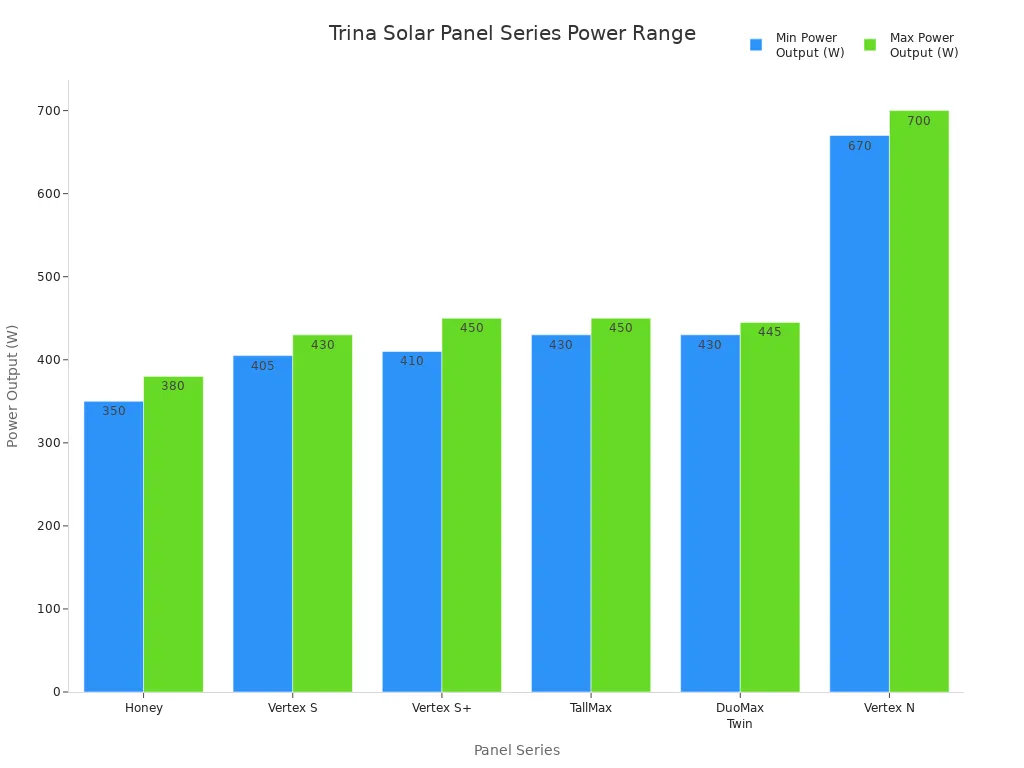
When you evaluate Trina Solar panel models, you encounter several series designed for different needs. Each series offers unique features, power ranges, and technologies. The following table summarizes the main series and their distinguishing characteristics:
Series | Power Range (W) | Distinguishing Features |
|---|---|---|
Honey | 350 – 380 | Affordable option, solid quality, and strong performance. Newer Honey M panels use half-cut PERC cells. |
Vertex S | 405 – 430 | Good residential panels offering value. Uses Monocrystalline PERC cells with efficiency rates up to 21.3%. |
Vertex S+ | 410 – 450 | High efficiency (22.5%), double-glass design, and advanced N-Type TOPCon technology. |
TallMax | 430 – 450 | Designed for commercial use, capable of handling high voltage and larger sizes. |
Vertex
You find the Vertex series at the top of Trina Solar’s portfolio. These panels use multi-busbar technology and deliver power outputs up to 670W. Vertex panels suit large-scale commercial and utility projects. You benefit from high efficiency and advanced bifacial options, which capture sunlight from both sides for greater energy yield.
Vertex S+
Vertex S+ panels target residential and small business installations. You get high efficiency up to 22.5%, a double-glass design for durability, and N-Type TOPCon cells for better performance in low-light conditions. The lighter weight and compact size make installation easier, especially on roofs with limited space.
Tallmax
Tallmax panels serve commercial and industrial applications. You see power outputs between 430W and 450W. These panels handle higher voltages and larger formats, which help you reduce installation costs for bigger projects. Tallmax models offer robust construction and reliable performance over time.
Honey
Honey panels provide an affordable entry point for homeowners and small businesses. You receive solid quality and dependable output between 350W and 380W. Newer Honey M panels use half-cut PERC cells, improving efficiency and shade tolerance. Honey series panels work well for budget-conscious buyers who want reliable solar energy.
Compare specs
You need to compare specifications to select the right panel for your project. The following table highlights key differences among the top series:
Series | Technology | Power Output | Efficiency |
|---|---|---|---|
Vertex | Multi-busbar | Up to 670W | High |
Vertex S | Monocrystalline PERC | 405–430W | Up to 21.3% |
Vertex S+ | N-Type TOPCon | 410–450W | Up to 22.5% |
Tallmax | High Voltage | 430–450W | Good |
Honey | Half-cut PERC | 350–380W | Solid |
Output
Vertex panels deliver the highest output, reaching up to 670W. Vertex S and Vertex S+ panels provide 405W to 450W, which fits most residential and small business needs. Tallmax and Honey panels offer reliable output for commercial and home use.
Efficiency
Vertex S+ panels lead in efficiency, reaching up to 22.5%. Vertex S panels follow with rates up to 21.3%. Honey and Tallmax panels offer good efficiency for their price points. Higher efficiency means you need fewer panels to meet your energy goals.
Size/weight
You must consider size and weight for installation. Vertex S panels measure 1.75m by 1.09m and weigh 21kg. This compact design makes them easy to handle and install, especially on smaller roofs. Installers prefer panels under 23kg and less than 1.8m in length. Vertex S meets these criteria, allowing you to install solar panels in areas with limited space.
Warranty
Warranty coverage varies by series. Standard product warranties last 12 years, with performance warranties up to 25 years. Vertex and Vertex S panels offer a 15-year product warranty, which you can extend to 25 years. Vertex S+ panels provide a 25-year product warranty and a 30-year performance warranty. You gain peace of mind knowing your investment is protected for decades.
Product Warranty: 12–25 years, depending on series.
Performance Warranty: 25–30 years, ensuring at least 80% of original output.
Use cases
You should match panel series to your specific application for best results.
Home
Vertex S and Honey panels work well for residential rooftops. You get easy installation, good efficiency, and reliable output. Vertex S+ panels suit premium home installations, offering higher efficiency and longer warranties.
Business
Tallmax and Vertex panels fit commercial buildings and small businesses. You benefit from higher output and robust construction. Vertex S+ panels also serve small businesses that want advanced technology and durability.
Off-grid
Honey and Vertex S panels support off-grid systems. You can use these panels for cabins, remote sites, and backup power. Their manageable size and weight simplify transport and installation in challenging locations.
Tip: Always assess your roof space, energy needs, and budget before choosing a Trina Solar panel series. Matching the right model to your application ensures maximum value and long-term satisfaction.
Price/value
Cost per watt
When you compare solar panels, cost per watt gives you a clear way to measure value. This metric shows how much you pay for each watt of power your system can produce. Lower cost per watt means you get more energy for your money. Trina Solar panels offer competitive pricing compared to other leading brands.
Brand | Estimated cost per watt |
|---|---|
Trina Solar | $2.94 |
JA Solar | $2.94 |
Canadian Solar | $2.99 |
Qcells | $3.11 |
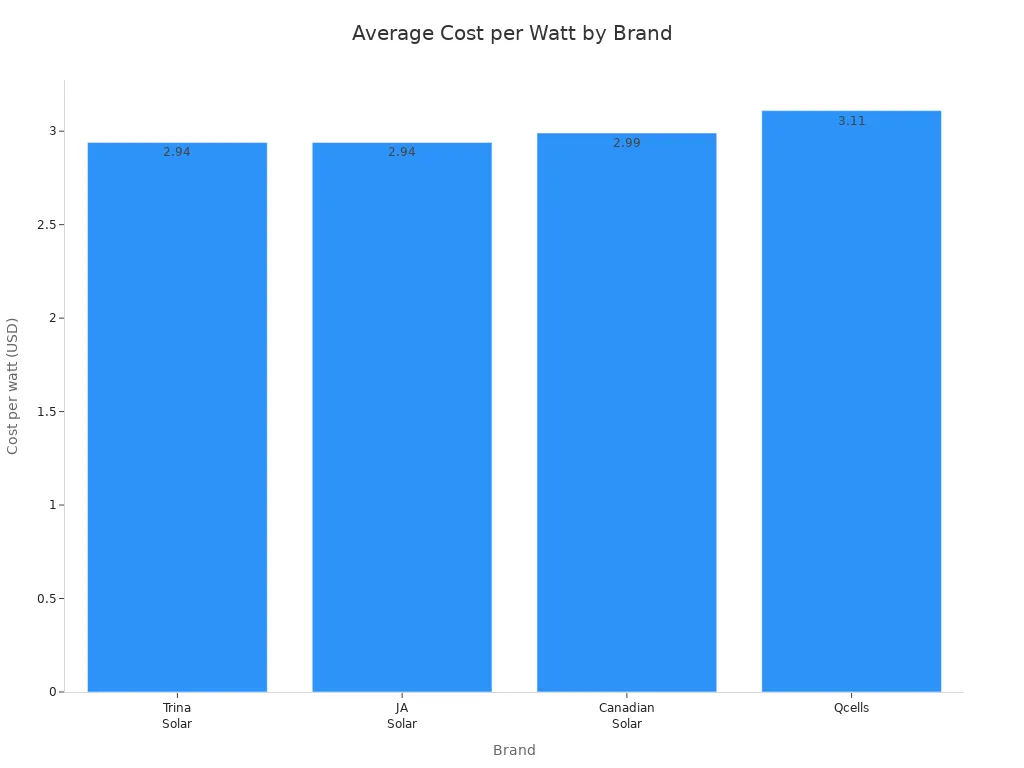
You see that Trina Solar panels match the lowest cost per watt among top brands. This makes them a smart choice if you want to maximize your solar investment without sacrificing quality or performance.
Tip: Always compare cost per watt when evaluating different solar panel models. This helps you find the best balance between price and long-term energy savings.
ROI
Return on investment (ROI) tells you how quickly your solar system pays for itself and starts saving you money. Trina Solar panels deliver strong ROI in both residential and commercial settings. The table below shows typical ROI percentages and the time it takes to reach a positive return:
Setting | Typical ROI (%) | Time to Positive Return (Years) |
|---|---|---|
Residential | 6-12 | |
Commercial | 8-20% | 6-12 |
California | >20% | 6-12 |
Minnesota | 8-12% | 6-12 |
You can expect to recover your initial investment in about 6 to 12 years, depending on your location and energy usage. In states with high electricity rates, such as California, ROI can exceed 20%. After this period, your solar panels continue to generate free electricity, increasing your total savings year after year.
Note: Factors like local incentives, installation quality, and energy prices can affect your actual ROI. Always review your local policies and consult with a trusted installer for accurate projections.
Buying
Distributors
Choosing an authorized distributor ensures you receive genuine Trina Solar panels with full warranty protection. Authorized distributors also provide expert advice and support throughout your purchase and installation process. The table below lists major distributors and the benefits you gain by buying from them:
Authorized Distributors | Benefits of Purchasing |
|---|---|
SolarEnergySupplyStores.com | High efficiency (up to 22%) |
Distributors in Lagos, Abuja, Port Harcourt, Kano | Reliable under heat and humidity |
Certified solar installers | Durable frame and anti-PID protection |
N/A | 30-year performance warranty on many models |
N/A | Compatible with all major inverters and batteries |
You should always verify that your distributor is authorized. This protects your investment and ensures you receive the latest models and full manufacturer support.
Tip: Angsun Solar is a trusted distributor for Trina Solar panels. They offer expert guidance, competitive pricing, and reliable after-sales service.
Questions
Before you make your final decision, ask your distributor or installer these key questions:
Are the panels genuine and covered by the full manufacturer warranty?
What is the expected delivery time for my order?
Will the panels work with my existing inverter and mounting system?
What after-sales support and warranty services do you provide?
Can you help with local permits and incentive applications?
Asking these questions helps you avoid common pitfalls and ensures a smooth installation process. You gain peace of mind knowing your solar investment is protected and supported from start to finish.
Buying checklist
Factors
Compatibility
You must confirm that your chosen Trina Solar panels work seamlessly with your existing solar energy system. Compatibility affects performance and safety. Most Trina Solar panels integrate easily with mainstream optimizers, inverters, and mounting systems. This flexibility allows you to upgrade or expand your solar panels without major changes to your setup.
Check inverter specifications for maximum input voltage and current.
Review mounting system requirements for panel size and weight.
Ensure compatibility with battery storage if you plan to add it later.
Tip: Always consult your installer or distributor to verify that your Trina Solar panels match your system’s technical needs.
Regulations
You need to follow local and international regulations when buying and installing solar panels. Compliance ensures your solar energy system meets safety standards and qualifies for incentives. Trina Solar panels meet strict requirements for ethical sourcing and importation.
Regulation/Certification | Description |
|---|---|
UFLPA | Trina Solar complies with the Uyghur Forced Labor Prevention Act for all U.S. solar module imports, ensuring ethical sourcing practices. |
AD/CVD | Compliance with anti-dumping and countervailing duties for U.S. imports, as per the August 18, 2023 circumvention ruling. |
Ethical Sourcing | Trina has established a fully UFLPA-compliant supply chain since 2021, sourcing polysilicon from U.S. and European partners. |
You should check with your local authorities or installer for additional requirements in your region. Proper documentation helps you avoid delays and ensures your solar panels qualify for rebates.
Authenticity
Genuine panels
You want to make sure you receive authentic Trina Solar panels. Counterfeit products can lead to poor performance and void warranties. You can verify authenticity by following these steps:
Visit the official Trina Solar website.
Go to the module service page and select module authenticity.
Choose your country and enter the serial number found on your solar panels.
This process confirms that your panels are genuine and eligible for full manufacturer support.
Certified sellers
You should always buy from authorized distributors or brand-certified sellers. Trusted sellers guarantee you receive genuine Trina Solar products and full warranty coverage. Avoid unverified online marketplaces that offer discounted panels, as these may sell counterfeit or outdated products.
Purchase directly from authorized distributors.
Check for brand-certified sellers or their partners.
Avoid unverified online marketplaces.
Note: Buying from certified sellers protects your investment and ensures you receive reliable solar panels for your solar energy system.
Support
Service
You benefit from Trina Solar’s dedicated customer service team. Support is available worldwide, including technical assistance for installation and troubleshooting. You can contact their U.S. offices for help with system setup or performance issues.
Access technical support for installation and troubleshooting.
Reach out to customer service for general inquiries.
Warranty claims
You can make warranty claims for modules, cells, and individual parts through designated links on the Trina Solar website. Warranty claims are processed via online contact forms, making the process straightforward.
Contact technical service representatives for warranty claims.
Use the website contact forms to submit claims for specific components.
Tip: Keep your purchase documents and register your panels to simplify warranty claims and receive prompt support.
Install
Pro vs DIY
When you decide to install Trina Solar panels, you must choose between professional installation and a do-it-yourself approach. Each option offers unique benefits and challenges. You need to consider your budget, skill level, and long-term goals for your solar energy system.
Here is a comparison to help you make an informed decision:
Aspect | DIY Installation | Professional Installation |
|---|---|---|
Pros | Cost savings on labor costs. | Expertise and experience of certified installers. |
Cons | Complex set-up process leading to potential safety hazards and inefficiencies. | Higher upfront costs but seen as a long-term investment with warranties and maintenance. |
Limited knowledge may result in suboptimal panel placement. | Hassle-free process with adherence to safety and compliance regulations. |
If you choose DIY installation, you save money on labor. You handle the setup yourself, which can be rewarding if you enjoy hands-on projects. However, solar panel installation requires electrical knowledge and strict attention to safety. Mistakes can lead to poor performance or even damage to your Trina Solar panels. You may also face challenges with local permits and utility approvals.
Professional installation gives you peace of mind. Certified installers understand the technical requirements for Trina Solar panel systems. They follow safety codes and ensure your solar energy system meets all regulations. You pay more upfront, but you receive warranties and ongoing support. Most homeowners and businesses prefer professional installation for reliability and long-term value.
Tip: If you want maximum efficiency and warranty protection, choose a certified installer for your Trina Solar panels.
Site tips
Proper site preparation ensures your solar panels deliver optimal performance. You need to evaluate your roof or ground area before installation. Start by measuring available space and checking for shading from trees, chimneys, or nearby buildings. South-facing roofs usually provide the best sunlight exposure for solar energy systems.
Follow these steps to prepare your site:
Inspect your roof for structural integrity. Make sure it can support the weight of Trina Solar panels.
Remove any debris or obstacles that may block sunlight.
Confirm that your roof angle matches recommended tilt for your location. Most solar panels perform best at angles between 15° and 40°.
Check local building codes and utility requirements. You may need permits before installing solar panels.
Plan for future expansion. Leave space for additional panels if you expect your energy needs to grow.
You should also consider weather conditions in your area. Trina Solar panels withstand heavy wind and snow loads, but proper mounting is essential. Use high-quality racking systems and secure all connections to prevent damage.
Note: Always consult with your installer or distributor, such as Angsun Solar, for site-specific recommendations. They can help you optimize your solar energy system and avoid common pitfalls.
By following these tips, you set the foundation for a successful Trina Solar panel installation. You maximize energy production and protect your investment for years to come.
You now have the tools to make a smart Trina Solar panel purchase. Review the specs, compare models, and use the buying checklist to match your solar energy goals. If you need expert advice, reach out to trusted distributors like Angsun Solar. Remember, understanding datasheets and product details helps you choose the best solar panels for your home or business.
Tip: Confident decisions start with clear information—always check the details before you buy.
FAQ
What makes Trina Solar panels different from other brands?
Trina Solar panels offer high efficiency, robust warranties, and advanced technologies like N-Type TOPCon cells. You benefit from reliable solar energy production and strong durability, making them a top choice for both residential and commercial installations.
How do I verify the authenticity of my Trina Solar panels?
You can check the serial number on the official Trina Solar website. This step confirms your solar panels are genuine and eligible for full warranty support. Always buy from authorized distributors like Angsun Solar.
Can Trina Solar panels work with my existing inverter?
Most Trina Solar panels integrate easily with mainstream inverters. You should review your inverter’s specifications for voltage and current compatibility. Consult your installer to ensure seamless solar energy system performance.
What is the typical lifespan of Trina Solar panels?
You can expect Trina Solar panels to last 25 to 30 years. The performance warranty guarantees at least 80% output after 30 years. Regular maintenance helps maximize your solar energy investment.
Are Trina Solar panels suitable for off-grid systems?
Yes, you can use Trina Solar panels for off-grid solar energy solutions. Models like Honey and Vertex S provide reliable output and manageable size, making them ideal for cabins, remote sites, and backup power.
Do Trina Solar panels qualify for rebates and incentives?
Trina Solar panels carry certifications like IEC and UL, which help you qualify for local rebates and solar energy incentives. Check with your installer or local authorities for specific requirements in your area.
How does temperature affect Trina Solar panel performance?
High temperatures reduce solar panel output. Trina Solar panels have a temperature coefficient of -0.34%/°C. You can minimize losses by ensuring good airflow and proper mounting during installation.
Where can I get support for Trina Solar panel installation?
You receive technical support from Trina Solar’s customer service team and authorized distributors such as Angsun Solar. Professional installers provide guidance, warranty service, and help with permits for your solar energy system.
💡 Tip: Always consult certified installers for optimal solar panel performance and warranty protection.