
Imagine you want to maximize your solar energy output and wonder which inverter fits your solar panel system best. Micro-inverters often work well for homes with solar panels placed on complex roofs or areas with shade. Central inverters suit larger solar systems with simple layouts. Each inverter offers specific benefits for energy efficiency, cost, reliability, and safety. You should consider key factors like installation, system performance, lifetime costs, and monitoring. The table below highlights what most homeowners think about when choosing the best solar panel inverter for their solar power system:
Factor | Description |
|---|---|
Cost | Micro-inverters cost more per panel; central inverters reduce hardware costs for bigger solar systems. |
Installation | Central inverters use high-voltage DC wiring; micro-inverters use easier AC wiring. |
Reliability | Central inverters are a single point of failure; micro-inverters let the solar energy system keep working if one fails. |
Safety | Micro-inverters lower risks by converting DC to AC at the panel. |
Monitoring | Micro-inverters provide panel-level monitoring; central inverters offer system-level data. |
Scalability | Micro-inverters allow you to expand your solar system easily. |
Aesthetics | Micro-inverters stay hidden under panels; central inverters mount on walls and make noise. |
Key Takeaways
Micro-inverters optimize energy production by allowing each solar panel to operate independently, making them ideal for shaded or complex roofs.
Central inverters are cost-effective for large, unshaded solar systems, as they reduce hardware costs and simplify maintenance.
Choose micro-inverters for flexibility and easy expansion; you can add panels without reconfiguring the entire system.
Consider the installation environment: micro-inverters are better for roofs with multiple angles, while central inverters suit straightforward layouts.
Micro-inverters provide panel-level monitoring, allowing you to quickly identify and address issues, enhancing overall system efficiency.
Central inverters can suffer significant output losses if one panel in the string is shaded, affecting the entire system’s performance.
Evaluate long-term costs: micro-inverters may have higher upfront costs but can save you money over time due to their durability and efficiency.
Consult a solar professional to assess your specific needs and ensure you choose the right inverter for your solar power system.
Micro-inverters vs. Central Inverter Basics
Micro-inverters Overview
You may notice that micro-inverters have become popular for residential solar installations. These small devices attach directly to the back of each solar panel. Micro-inverters convert the direct current (DC) produced by individual panels into alternating current (AC) right at the source. This design allows each panel to operate independently, so if one panel experiences shading or a drop in performance, the others continue to produce energy at their maximum potential. Microinverters use advanced power point tracking and pulse width modulation to optimize energy conversion for every panel. You benefit from increased efficiency and easier system expansion, especially if your roof has multiple angles or partial shading.
Microinverters connect to one or two solar panels individually.
Each micro-inverter maximizes output by converting DC to AC at the panel level.
If one panel underperforms, the rest of your system keeps working efficiently.
Micro-inverters are small, hidden under panels, and support flexible solar system design.
Central Inverter Overview
Central inverters remain the standard for large solar systems and commercial installations. You will find these units mounted on a wall, usually near your electrical panel. A central inverter connects multiple solar panels in series, collecting the DC electricity from all panels and converting it into AC for your home or the grid. This centralized approach works best when all panels receive similar sunlight and face the same direction. If one panel becomes shaded or fails, the performance of the entire string can drop. Central inverters offer lower upfront costs for bigger systems and simplify maintenance, but they present a single point of failure.
Tip: Central inverters are ideal for installations with consistent sunlight and simple roof layouts.
How Microinverters and Central Inverters Work
Both micro-inverters and central inverters perform the essential job of converting DC electricity from solar panels into AC electricity for home use. The main difference lies in where and how this conversion happens.
Feature/Aspect | Central Inverter | Micro Inverter |
|---|---|---|
Connection | Connects multiple panels in series | Connects to one or two panels individually |
Energy Harvesting | Performance affected by shading on any panel | Each panel operates independently, maximizing output |
Reliability | Failure affects the entire system | Failure affects only the corresponding panel |
Scalability | More complex to add panels | Easy to add panels with individual inverters |
Cost | Lower initial cost for large systems | Higher initial cost due to multiple inverters |
Best Use Case | Large-scale installations | Residential and small commercial installations |
Micro-inverters convert DC to AC at the panel level, right on your roof.
Central inverters convert DC to AC for the entire solar array at a single location.
Microinverters allow for panel-level optimization, while central inverters optimize at the system level.
You should choose micro-inverters if you want maximum flexibility, easy expansion, and reliable performance in shaded or complex roof environments. Central inverters suit you best if you have a large, unshaded solar system and want to minimize upfront costs.
Performance
Shading and Panel Orientation
Micro-inverters in Shaded Solar Systems
You often face shading issues if your roof has trees, chimneys, or nearby buildings. Micro-inverters offer a strong solution for these challenges. When you use micro inverters, each solar panel operates independently. If one panel gets shaded, only that panel’s output drops. The rest of your solar panels continue to perform at their best. This panel-level optimization ensures you get the most energy possible, even in tough conditions.
Micro-inverters maintain optimal performance even when some panels are shaded.
You benefit from isolated panel performance, so shading on one panel does not affect the others.
Microinverters are ideal for homes with complex roof shapes or partial shading.
If one panel is shaded, the others keep producing electricity efficiently.
Micro inverters minimize energy loss, which is crucial for maximizing your solar investment.
Central Inverter in Shaded Solar Systems
Central inverters work differently. When you use a central inverter, all panels connect in series. If one panel gets shaded, the performance of the entire string drops. You may see output losses of up to 50% or more if a single panel is shaded. This system-level approach makes central inverters less suitable for roofs with frequent shading or multiple angles.
Central inverters can suffer significant output losses due to shading on any single panel.
The weakest panel in the string determines the overall performance.
You may need to avoid central inverters if your roof faces shading issues.
Efficiency
Panel-level Optimization (Micro-inverters)
Micro-inverters deliver high efficiency through panel-level optimization. Each microinverter tracks and converts energy for its own panel. This method ensures that shading or dirt on one panel does not reduce the output of the others. You see higher overall energy production, especially on roofs with complex layouts or inconsistent sunlight.
Microinverters enable each solar panel to function independently.
If one panel is shaded, it does not diminish the performance of the other panels.
This feature leads to increased overall electricity generation.
Micro inverters optimize the performance of each solar panel, enhancing system efficiency.
Inverter Type | Efficiency Rating |
|---|---|
Microinverters | 95-97% |
Top-tier Models | 98% or higher |
System-level Optimization (Central Inverter)
Central inverters optimize at the system level. You get high efficiency when all panels receive equal sunlight. Top-tier central inverters reach efficiency ratings of 98% or higher. However, if one panel underperforms, the entire system’s output drops. This approach works best for large solar systems with uniform panel orientation and minimal shading.
Inverter Type | Efficiency Rating |
|---|---|
Central Inverters | 98% or higher |
Microinverters | 95-97% |
Note: For maximum efficiency, choose micro-inverters if your roof has shading or complex angles. Select central inverters for large, unshaded solar systems.
Cost
Upfront Cost
Equipment and Installation
When you compare micro-inverters and central inverters, you notice a clear difference in upfront costs. Micro inverters typically cost about 35% more than central inverters. You pay for each micro-inverter installed on every solar panel, which increases the total equipment expense. Central inverters, on the other hand, manage multiple panels with one device, reducing hardware costs for larger solar systems.
Inverter Type | Typical Cost Range |
|---|---|
Micro-inverters | |
Central inverters | Varies significantly based on project size and complexity |
Installation labor also impacts your budget. Microinverters require individual installation on each panel, which increases labor time and cost. You may see labor costs rise by $0.10 to $0.20 per watt for micro inverters. Central inverters simplify the process, often reducing installation costs by $0.05 to $0.10 per watt. If you have a large, unshaded roof, central inverters offer a more cost-effective solution.
Microinverters increase labor costs due to individual panel installation.
Central inverters reduce installation time and expense for bigger solar systems.
Micro-inverters suit smaller, complex installations, while central inverters excel in large, simple layouts.
Lifetime Cost
Maintenance and Repairs
You should consider lifetime costs when choosing inverters for your solar system. Micro inverters have a higher initial investment, but they can save you more over time. Over a 25-year period, micro inverters may save you up to $2,000 more than string inverters. Microinverters typically last 20 to 25 years, while central inverters usually last 10 to 15 years. Longer lifespans mean fewer replacements and lower maintenance costs.
Inverter Type | Initial Cost | Total Savings Over 25 Years |
|---|---|---|
Micro Inverters | $2,750 | $19,800 |
Central Inverters | $1,700 | $18,000 |
Microinverters have a life expectancy of 20 to 25 years.
Central inverters last 10 to 15 years, often requiring replacement during the system’s lifetime.
Micro inverters provide better value over time due to panel-level optimization and longer warranties.
Warranty
Warranty coverage plays a key role in your long-term costs. Micro-inverters usually come with warranties of 20 to 25 years. Central inverters typically offer warranties from 5 to 10 years, with some options to extend up to 20 years. Longer warranties mean you spend less on repairs and replacements.
Inverter Type | Warranty Period |
|---|---|
Micro-inverters | 20-25 years |
Central inverters | 10-12 years |
Micro-inverters have longer lifespans and warranties compared to central inverters.
Central inverters offer shorter warranty periods, which may increase your maintenance expenses.
Tip: If you want lower upfront costs for a large, unshaded solar system, choose a central inverter. If you prefer long-term savings and reliability, micro inverters provide better value.
Reliability
Durability
Environmental Exposure (Micro-inverters)
You need to consider how environmental factors affect the reliability of your solar inverter system. Micro-inverters operate directly at the panel level, which means they face outdoor conditions such as heat, cold, moisture, and dust. Manufacturers design these devices to withstand harsh environments, so you can expect them to last for decades. In real-world installations, micro-inverters often match the lifespan of solar panels, reaching up to 25 years or even 30 years in some cases. This durability ensures that your system continues to produce energy efficiently, even when individual panels experience shading or hardware issues.
Micro-inverters can last up to 30 years.
Most models have a lifespan of 20 to 25 years, comparable to solar panels.
Each unit operates independently, maintaining output even if one panel faces environmental challenges.
You benefit from steady energy production, especially in areas with unpredictable weather.
Micro-inverters maintain a high level of performance even in shaded conditions, as each panel operates independently.
Central Inverter Location
You will usually find the central inverter installed indoors or in a sheltered outdoor area. This location protects the device from direct exposure to weather, which can extend its lifespan. However, central inverters typically last around 10 years, with premium models reaching up to 20 years. If one panel in the string fails or becomes shaded, the central inverter may experience performance degradation, sometimes leading to system-wide issues. You should monitor the inverter’s environment to prevent overheating and dust buildup.
Central inverters last about 10 to 15 years on average.
Premium models can reach up to 20 years.
Indoor installation reduces exposure to harsh weather.
System reliability depends on the weakest panel in the string.
Maintenance
You must perform regular maintenance to keep your solar inverter system running smoothly. Both micro-inverters and central inverters require attention, but the tasks differ slightly.
Inspect your system visually at least once a month.
Check for error codes and fault warnings on the inverter display.
Monitor performance metrics using online tools.
Clean the inverter to prevent dust accumulation.
Ensure proper ventilation to avoid overheating.
Inspect wiring, terminals, and ground connections for signs of wear.
Micro-inverters offer easier troubleshooting because you can identify and address issues at the panel level. If one unit fails, you only need to replace that specific device. With a central inverter, a single failure can affect the entire system, requiring more extensive repairs. You should schedule routine checks to maximize the lifespan and reliability of your solar investment.
Safety
Electrical Safety
You need to prioritize electrical safety when choosing between micro-inverters and central inverters. Micro-inverters operate at lower voltages, typically under 60 volts DC. This design reduces the risk of arc faults and minimizes dangerous heat buildup. Lower voltage means you face fewer electrical hazards during installation and maintenance. Central inverters, on the other hand, use high-voltage DC wiring—sometimes up to 600 volts. High voltage increases the risk of electric shock and arc faults, especially if the wiring becomes damaged or improperly installed.
Manufacturers must comply with strict safety standards for both inverter types. These standards ensure that your system operates safely and reliably. Here is a summary of key safety standards for residential inverters:
Standard | Description |
|---|---|
EN 62109-1/-2 | Safety requirements for inverters |
EN 61000-6-1/-2/-3/-4 | Electromagnetic compatibility standards |
EN 50549-1 | Standards for PV systems grid connection |
CEI 0-21 | Grid connection requirements for Italy |
VDE-AR-N 4105 | Grid connection standard for Germany |
Tip: Micro-inverters’ lower voltage design makes them safer for homeowners and installers, especially during maintenance or emergency situations.
Fire Risk
You should also consider fire risk when selecting an inverter for your solar system. Micro-inverters enhance safety by eliminating high DC voltage at the system level. They operate at lower voltages, usually around 240 volts AC, which reduces the chance of electrical fires. Central inverters, in contrast, require high-voltage DC wiring across your roof. This wiring can reach up to 600 volts, increasing the risk of electrical arcs and potential fire hazards if the system becomes damaged.
Micro-inverters offer rapid shutdown capabilities. This feature allows you to quickly de-energize the system in case of an emergency. Rapid shutdown protects firefighters and first responders, making it easier and safer for them to work on your property during a fire or other crisis. Central inverters may not always provide this feature, or it may require additional equipment.
Micro-inverters reduce fire risk by operating at lower voltages.
Rapid shutdown features improve safety for emergency responders.
Central inverters carry higher fire risk due to high-voltage DC wiring.
Note: Choosing micro-inverters can give you peace of mind, knowing your solar installation meets the latest safety standards and offers advanced protection features.
Monitoring
Panel-level Monitoring (Micro-inverters)
You gain a significant advantage with panel-level solar monitoring when you choose micro-inverters. This technology lets you track the performance of each solar panel in real time. You can quickly spot issues, such as dirt, shading, or hardware faults, on a specific panel. You receive immediate alerts if a panel underperforms, which helps you maintain system efficiency and safety.
You see at least a 10% increase in efficiency because you can address problems as soon as they arise.
You identify and fix issues with individual panels, preventing small problems from affecting your entire solar array.
You benefit from enhanced safety since the system sends alerts for any panel malfunction.
You maintain reliable energy production, even if one panel fails, because the rest of your system keeps working.
Panel-level solar monitoring ensures that each panel operates independently. You get consistent output, even when some panels face shade or suboptimal angles. You can use your monitoring app to check the status of every panel, making troubleshooting fast and easy. This level of control gives you peace of mind and helps you maximize your solar investment.
Tip: Panel-level solar monitoring helps you protect your system’s performance and quickly resolve any issues.
System-level Monitoring (Central Inverter)
Central inverters provide system-level solar monitoring, which means you track the overall performance of your solar array rather than each panel. You see aggregate data for the entire string of panels. This approach works well for large installations with uniform sunlight and simple layouts.
Monitoring Type | Data Granularity | Troubleshooting Capability |
|---|---|---|
System-Level Monitoring | Aggregate performance of the entire string | Cannot identify specific underperforming panels |
Panel-Level Monitoring | Individual performance of each panel | Immediate identification of issues with specific panels |
You may find it harder to pinpoint problems with system-level solar monitoring. If your system’s output drops, you need to inspect each panel manually to find the cause. You do not receive alerts for individual panel failures, which can delay repairs and reduce overall efficiency. You rely on periodic checks and maintenance to keep your system running smoothly.
Note: System-level solar monitoring suits large, unshaded solar systems where panels perform similarly. You should consider panel-level monitoring if you want detailed insights and faster troubleshooting.
Scalability
Expanding Solar Systems
You may want to expand your solar system as your energy needs grow. Micro-inverters make this process simple. You can add new panels at any time, and each panel comes with its own micro-inverter. This modular approach means you do not need to upgrade your existing inverter or worry about compatibility issues. You avoid the risk of overloading the system, and you can mix different panel models or wattages without negative impacts.
You add new panels easily, each with its own micro-inverter.
You do not need to upgrade a central inverter.
You mix and match panel types for greater flexibility.
You avoid system downtime during expansion.
Central inverters require more planning. You must consider the inverter’s capacity and compatibility with new panels. Sometimes, you need to upgrade the central inverter or reconfigure the system to accommodate additional panels. This process can increase costs and complexity, especially for large installations.
System Type | Expansion Ease | Notes |
|---|---|---|
Micro-inverter | Easy to expand; each panel has its own micro-inverter, allowing flexibility | New panels can be added without affecting existing ones, enabling different models/wattages |
Central inverter | More complex; requires consideration of inverter capacity and compatibility | Expansion may necessitate upgrading the central unit or ensuring compatibility with existing panels |
If you use advanced models like the growatt pv inverter, you may find some central inverters offer better scalability than older units. However, micro-inverters remain the most flexible choice for homeowners who want to expand their systems over time.
Tip: Choose micro-inverters for hassle-free expansion and future-proofing your solar investment.
Design Flexibility
Your roof may have an irregular shape, multiple angles, or areas with shade. Micro-inverters give you the freedom to design a solar system that fits your unique layout. Each panel operates independently, so shading or orientation issues on one panel do not affect the others. You maximize energy production, even if some panels face different directions or receive less sunlight.
Feature | Micro-inverters | Central Inverters |
|---|---|---|
Operation | Each panel operates independently | All panels connected to a single inverter |
Performance Impact | Shading on one panel does not affect others | Shading can reduce overall system performance |
Monitoring | Panel-level monitoring available | Limited to system-level monitoring |
Design Flexibility | High, suitable for irregular layouts | Lower, less adaptable to complex structures |
System Expansion | Easy to add new panels without reconfiguration | May require reconfiguration for new panels |
Micro-inverters allow you to monitor each panel’s performance in real time. You identify issues quickly and maintain optimal output. Their modular design lets you add panels without reconfiguring the entire system. If you want the best pure sine wave inverter performance for a complex roof, micro-inverters deliver reliable results.
Central inverters work best for simple, uniform roof layouts. You may face challenges if your roof has multiple angles or frequent shading. Expansion and reconfiguration often require professional help and additional costs.
Micro-inverters enhance energy harvest in homes with shading issues.
You monitor each panel’s output for maximum efficiency.
You expand your system easily, even with different panel types.
If you plan to install a 1000w pure sine wave inverter or similar devices, consider how your inverter choice affects system design and scalability. Micro-inverters offer unmatched flexibility for growing and adapting your solar power setup.
Note: Micro-inverters provide the highest level of design flexibility and scalability, making them ideal for residential systems with complex roofs or plans for future expansion.
Installation
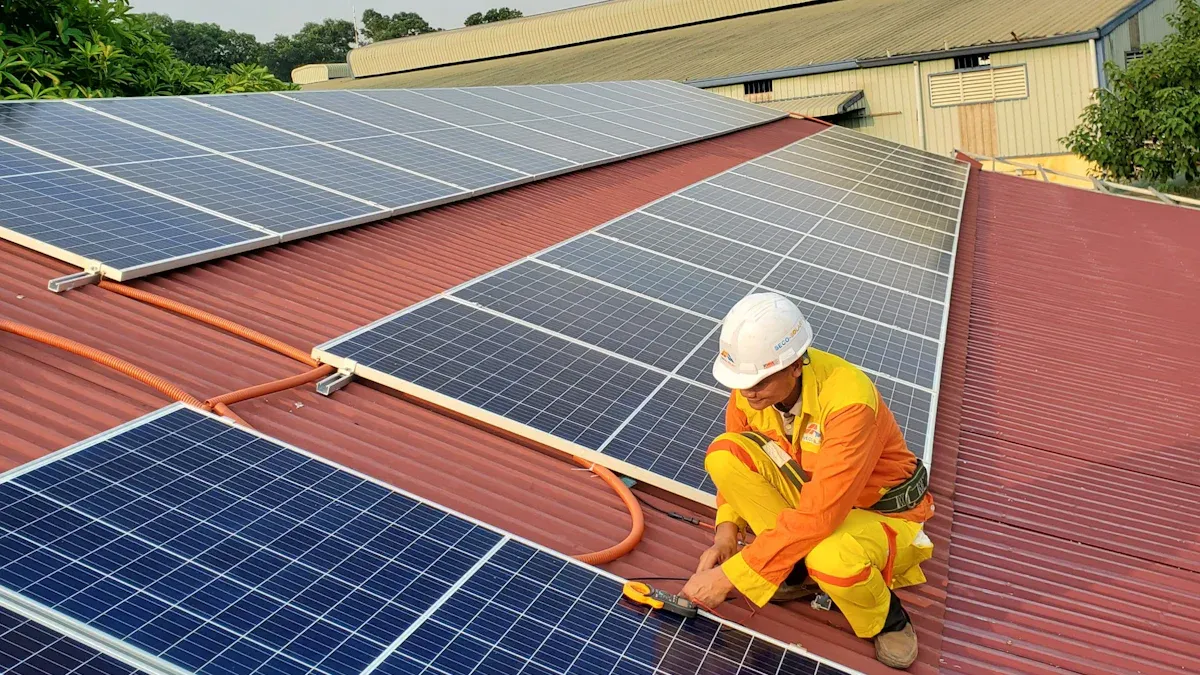
Micro-inverters Installation
When you choose micro-inverters for your solar installation, you follow a straightforward process that ensures each panel operates at its best. Here are the main steps you can expect during installation:
Assess Your Energy Needs: Calculate your daily and monthly electricity use. This helps you decide how many solar panels and micro-inverters you need for your solar installation.
Choose the Right Location: Select a spot on your roof that receives the most sunlight. Avoid areas shaded by trees or nearby buildings.
Install the Solar Panels: Mount each panel securely at the best angle for sunlight. Follow the manufacturer’s guidelines for safety and efficiency.
Connect the Micro-inverters: Attach a micro-inverter to each solar panel. Make sure you connect the DC cables with the correct polarity to avoid issues.
Connect to the Electrical System: Link the micro-inverters to your main electrical panel. You should work with a licensed electrician for this step to meet local codes and ensure safety.
Test and Monitor: Check that each micro-inverter works properly. Use monitoring tools to track performance and catch any problems early.
Tip: Micro-inverters make it easy to expand your solar installation later. You can add more panels without major changes to your system.
Central Inverter Installation
Central inverters require a different approach during solar installation. You connect all your solar panels in series, forming a string that leads to a single inverter. This setup can make the process more complex, especially for larger systems.
You need to plan the layout carefully. Each panel in the string must face the same direction and receive similar sunlight. If one panel underperforms, the entire string’s output drops. The central inverter is usually installed indoors or in a sheltered outdoor space to protect it from weather. You must run high-voltage DC wiring from the panels to the inverter, which increases safety requirements and installation time.
The installation of micro-inverters is generally simpler and more efficient than central inverters. Micro-inverters allow each panel to operate independently, which can boost your overall energy production. Central inverters, however, require careful planning and more time, especially if your roof has a complex layout.
Project Timeline
The timeline for your solar installation depends on the inverter type and system size. Micro-inverter systems often move faster because you install and test each panel independently. Most residential micro-inverter installations finish within one to three days, depending on the number of panels and roof complexity.
Central inverter installations can take longer. You need extra time for string layout, high-voltage wiring, and inverter setup. For large or commercial solar installation projects, expect the process to last several days or even a week.
Inverter Type | Typical Installation Time | Complexity Level |
|---|---|---|
Micro-inverters | 1-3 days | Low to Moderate |
Central Inverter | 2-7 days | Moderate to High |
Note: You should always work with experienced solar installation professionals. They ensure your system meets safety standards and delivers reliable performance.
Best Uses for Each Inverter
Residential Solar
When you consider residential solar panel systems, you want a solution that balances cost, reliability, and ease of maintenance. Most homeowners choose string inverters, also known as central inverters, for their cost-effectiveness and straightforward operation. These inverters convert DC energy from your solar panels into AC power for your home. You benefit from a lower upfront investment and a system that is easy to maintain. Central inverters have a proven track record in residential settings, making them a popular choice for standard installations.
However, your decision should also account for your roof’s layout and sunlight exposure. If your home experiences partial shading or has a complex roof design, microinverters may offer better performance. Microinverters optimize each panel individually, so shading on one panel does not reduce the output of the entire system. This feature ensures you get the most energy possible, even if some panels receive less sunlight during the day. You can monitor each panel’s performance and address issues quickly, which helps maintain high efficiency over time.
Tip: For most residential solar panel systems with consistent sunlight, central inverters provide a cost-effective and reliable solution. If your roof has shading or multiple angles, microinverters deliver superior performance and flexibility.
Commercial Solar
Commercial solar projects require you to consider factors such as system size, efficiency, installation environment, and monitoring capabilities. You often deal with larger arrays and higher power demands. Central inverters remain the standard for commercial installations due to their scalability and ability to handle high-capacity systems. You can install these inverters indoors or in protected outdoor spaces, which helps extend their lifespan and simplifies maintenance.
When you select an inverter for a commercial project, you need to evaluate several key considerations:
Key Consideration | Factors to Consider |
|---|---|
System Size and Capacity | Power rating, scalability |
Efficiency | Conversion efficiency, European efficiency |
Installation Environment | Indoor vs. outdoor installation, temperature range, weather resistance |
Compatibility with Solar Panels | Voltage and current matching, string length |
Monitoring and Control Features | Monitoring capabilities, remote access, data logging |
Grid Integration | Grid compliance, grid support functions |
Warranty and Support | Warranty period, service and support |
You should choose central inverters for large, unshaded commercial rooftops or ground-mounted arrays. These systems benefit from lower hardware costs and centralized monitoring. If your commercial site has areas with variable sunlight or complex layouts, microinverters can provide panel-level optimization and easier system expansion. Microinverters also allow you to track performance at the panel level, which can be valuable for troubleshooting and maximizing output in challenging environments.
Shaded or Complex Roofs
If your property has a roof with multiple angles, partial shading, or obstructions like chimneys and vents, you face unique challenges. Microinverters offer the best solution for these situations. You gain several advantages when you use microinverters on shaded or complex roofs:
Microinverters minimize the impact of shading on your entire solar array. Only the shaded panel’s efficiency drops, while the rest of your system continues to operate at peak performance.
Each panel works independently, so you avoid significant power loss even if one or more panels experience reduced sunlight.
Microinverters allow for individual panel optimization, which is crucial when sunlight exposure varies across your roof.
You can expand your system easily and mix different panel types or wattages without compatibility issues.
Central inverters, by contrast, can lead to substantial power loss if any part of your solar array is shaded. The weakest panel in the string determines the output for the entire system. If your roof experiences shading throughout the day, you should consider microinverters to maintain high efficiency and maximize your solar investment.
Note: Microinverters excel on roofs with complex layouts or partial shading. You ensure consistent energy production and simplify troubleshooting by isolating each panel’s performance.
Future Expansion
When you plan for the future of your solar power system, flexibility becomes a top priority. Your energy needs may grow as you add electric vehicles, new appliances, or even a home addition. Choosing the right inverter now can make future expansion much easier and more cost-effective.
Micro-inverters stand out for their exceptional scalability. You can add new solar panels one at a time without reconfiguring your entire system. This modular approach means you do not need to replace your existing inverter or worry about compatibility issues. If you want to install a 1000w pure sine wave inverter or upgrade to the best pure sine wave inverter for sensitive electronics, micro-inverters allow you to expand your array without hassle.
Here is a comparison of key benefits for future expansion:
Benefit | Description |
|---|---|
Scalability | Micro-inverters allow for easy expansion by adding panels one by one without redoing the setup. |
Efficiency | They often achieve over 98% efficiency, leading to faster savings despite higher initial costs. |
Simplified Installation | Their plug-and-play setup reduces wiring complexity, saving on labor time and costs. |
Tip: Micro-inverters use a plug-and-play design. You can add panels as your budget or energy needs grow, making them ideal for homeowners who want to start small and expand later.
Central inverters, such as the growatt pv inverter, work best when you install all panels at once. If you want to expand later, you may need to upgrade the central inverter or redesign your system. This process can increase costs and require more labor. Central inverters suit large, stable installations where you do not expect significant changes in energy demand.
You should also consider monitoring and maintenance. Micro-inverters provide panel-level monitoring, so you can track the performance of each new panel as you expand. This feature helps you identify issues quickly and maintain high efficiency across your entire system.
Pros and Cons
Micro-inverters Pros and Cons
You gain several benefits when you choose micro-inverters for your solar system. Each panel operates independently, which means shading or dirt on one panel does not affect the others. You see higher energy production on complex roofs or in areas with partial shade. Micro-inverters offer panel-level monitoring, so you can track performance and identify issues quickly. You also enjoy easier system expansion, since you can add panels without reconfiguring the entire setup.
However, you face higher upfront costs. Micro-inverters require more labor during installation, and each panel needs its own device. You may encounter more points of failure, since every panel has an inverter. Environmental exposure can affect durability, although most models withstand harsh conditions for decades.
Pros:
Panel-level optimization boosts energy harvest in shaded or complex layouts.
Easy expansion and flexible design for future growth.
Enhanced safety due to lower voltage at the panel.
Real-time monitoring for each panel.
Cons:
Higher initial cost for equipment and installation.
More devices mean increased potential for individual failures.
Exposure to outdoor elements may impact lifespan.
Tip: Micro-inverters work best for homes with complex roofs, partial shading, or plans for future expansion.
Central Inverter Pros and Cons
You benefit from lower upfront costs when you select a central inverter for your solar installation. One device manages the entire array, which simplifies maintenance and reduces hardware expenses. Central inverters suit large, unshaded systems with uniform panel orientation. You often see longer durability, since the inverter stays protected indoors or in a sheltered area.
You face some drawbacks. Shading or failure on one panel can reduce the output of the whole string. Expansion requires careful planning and may need a new inverter. System-level monitoring makes it harder to pinpoint issues with individual panels.
Pros | Cons |
|---|---|
Lower upfront cost | Performance drops with shading |
Simplified maintenance | Single point of failure |
Durable indoor installation | Limited design flexibility |
Ideal for large systems | Harder to expand or reconfigure |
Note: Central inverters provide a cost-effective solution for large, simple solar arrays with consistent sunlight.
Choosing the Right Inverter
Key Questions
Selecting the right inverter for your solar power system requires careful consideration. You should ask yourself several important questions before making a decision. Your answers will help you match your solar installation to your home’s needs and maximize your investment.
Here are some essential questions to guide your choice:
What is the layout of your roof?
If your roof has multiple angles or experiences shading from trees or nearby buildings, you may benefit from micro-inverters. These devices optimize each panel individually, so shading on one panel does not affect the others.What is your budget for initial installation?
Micro-inverters usually cost more upfront because you need one for each panel. Central inverters offer a lower initial cost, especially for larger systems with uniform sunlight.How important is monitoring and troubleshooting?
Micro-inverters allow you to monitor each panel’s performance. You can quickly identify and fix issues at the panel level. Central inverters provide system-wide monitoring, which may make troubleshooting more challenging.What are your long-term maintenance goals?
Micro-inverters typically last longer and make it easier to pinpoint problems. Central inverters may require replacement sooner and can be harder to maintain if a single panel fails.Is your system likely to expand in the future?
If you plan to add more panels later, micro-inverters offer greater flexibility. You can expand your system without replacing the main inverter.
The following table summarizes key aspects to consider:
Aspect | Micro-Inverters | Central Inverters |
|---|---|---|
Installation | Mounted on each solar panel | Mounted on the home |
Performance in Shading | Better performance in shaded conditions | Performance can drop significantly in shade |
Cost | Generally higher initial cost | Lower initial cost |
Monitoring | Individual panel monitoring available | System-wide monitoring only |
Maintenance | Easier to identify issues at the panel level | Harder to pinpoint issues |
Lifespan | Typically longer lifespan | May require replacement sooner |
Suitability | Ideal for complex roof designs with shading | Suitable for straightforward installations |
Tip: You should review these aspects and match them to your home’s unique requirements. Your answers will help you choose the inverter that delivers the best performance and value.
Consult a Solar Professional
You should always consult a qualified solar professional before finalizing your inverter choice. An expert can assess your roof’s layout, shading patterns, and energy needs. You receive personalized recommendations based on your budget and long-term goals. A professional will also ensure your system meets local codes and safety standards.
Solar professionals use advanced tools to model your system’s performance. You gain insights into how different inverter types will impact your energy production and savings. You also receive guidance on warranties, maintenance schedules, and future expansion options.
Note: A solar expert can help you avoid costly mistakes and maximize your return on investment. You should schedule a consultation before purchasing equipment or signing installation contracts.
You make a smart investment when you combine your research with professional advice. Your solar power system will deliver reliable performance for years to come.
You should match your inverter choice to your solar needs. Micro-inverters work best for homes with shading or complex roofs. Central inverters suit large, unshaded systems and commercial projects. Use this quick guide:
Homeowners: Micro-inverters for flexibility and monitoring.
Commercial users: Central inverters for cost savings.
Shaded or complex roofs: Micro-inverters for reliable output.
Assess your goals and consult a solar expert for the best results.
FAQ
What is the main difference between micro-inverters and central inverters?
Micro-inverters convert DC to AC at each panel. Central inverters convert DC to AC for the entire solar array. You get panel-level optimization with micro-inverters. Central inverters optimize at the system level.
Are micro-inverters worth the higher upfront cost?
You pay more for micro-inverters, but you gain better performance on shaded or complex roofs. You also get longer warranties and easier expansion. Over time, you may save more due to higher efficiency and lower maintenance.
Can I use a 1000w pure sine wave inverter for my solar system?
You can use a 1000w pure sine wave inverter for small off-grid solar setups. For grid-tied residential or commercial systems, you need micro-inverters or central inverters designed for solar applications.
How do I monitor the performance of each solar panel?
Micro-inverters provide panel-level monitoring. You track each panel’s output using a mobile app or web portal. Central inverters offer system-level monitoring, so you see only the total output.
Is the growatt pv inverter a good choice for commercial solar?
You can choose the growatt pv inverter for large commercial installations. It offers high efficiency, robust monitoring, and reliable grid integration. You should consult a solar professional to confirm compatibility with your system.
What happens if one micro-inverter fails?
If one micro-inverter fails, only the connected panel stops producing power. The rest of your system keeps working. You replace the faulty micro-inverter without affecting other panels.
Which inverter type is safest for my home?
Micro-inverters operate at lower voltages, reducing electrical and fire risks. You get rapid shutdown features for emergencies. Central inverters use higher voltage DC wiring, which requires extra safety precautions.
How do I choose the best pure sine wave inverter for my needs?
You should consider your power requirements, system size, and compatibility with solar panels. Look for inverters with high efficiency, strong warranties, and reliable support. Ask a solar expert for recommendations based on your setup.